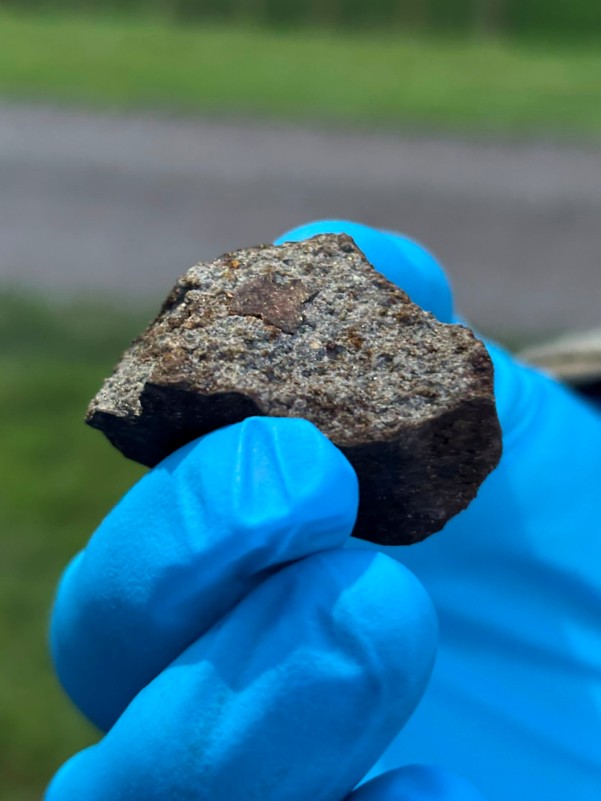
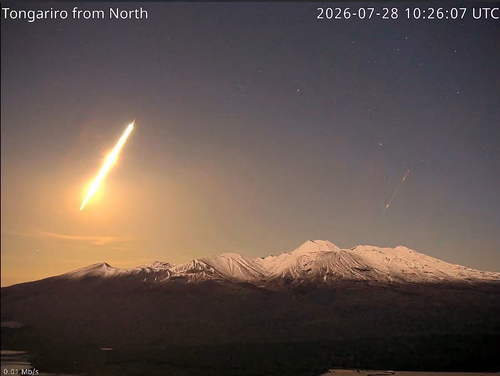
On the 28th of August, at 10.26 pm, a rock from space shot across Earth’s atmosphere over the lower North Island. The associated fireball was seen and reported widely, with many in the Kapiti to Masterton region describing the amazing sight. One anonymous person in Feilding writing on the fireball report page that the “Sky lit up like a bonfire in flames.”
A sonic boom was heard shortly afterwards by people on the Kapiti Coast and around Western Wairarapa. One person from East Taratahi reported ”It consisted of multiple crackles, several distinct booms, and prolonged rolling rumbling, giving the impression of an object travelling through the atmosphere and fragmenting repeatedly”, which is exactly what happened. Since the soundwaves travel slower than light, these arrived shortly after the fireball.
The trajectory of the fireball was calculated by Fireballs Aotearoa using meteor cameras that are distributed across New Zealand as part of a large citizen science project (www.fireballs.nz) aimed at recovering meteorites and documenting meteor showers above New Zealand.
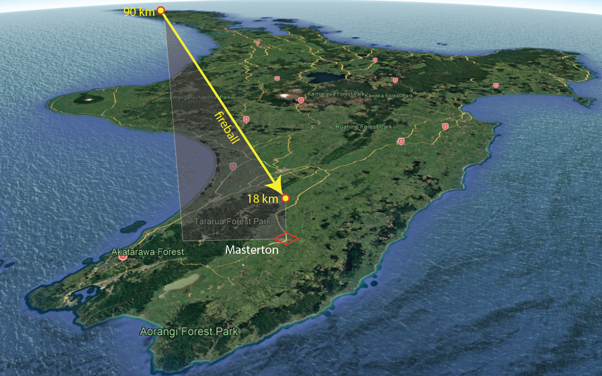
“The camera data showed to us that the meteor was first visible in Earth’s atmosphere at 90 km, where it was travelling at a rapid 14 km/s. This speed represents what it has been travelling at for millions of years around the Sun. However, as it reached to 30 km above the Earth, it began to rapidly decelerate, and by 18 km it was travelling at “only” 2 km/s. Through this phase, the air in front of the meteorite was compressed and heated up, causing the outside of the rock to melt. This gave the bright fireball trail seen across the night sky” said Steve Wyn-Harris, Director of Fireballs Aotearoa.
“During the fireball stage, small meteors generally lose between 90 and 100% of their mass. Shooting stars, for example, are typically only pea-sized and burn up completely. However, if a meteor has a steep entry, or started out as a mass of more than about 10 kg, some portions may survive the transit through the atmosphere. The rocks that land on the ground are called meteorites. The 813 gm Takapō Meteorite found by Fireballs Aotearoa in March 2024 started out at the top of the atmosphere at approximately 14 kg” said Dr. Marshall Palmer of Fireballs Aotearoa.
In the last stages of the fireball, the meteor cameras imaged several fragmentation events of the rock, indicating the possibility of many fragments on the ground. This occurred because the forces on either side of the meteorite were so unequal that the rock ripped itself apart. Just 7 seconds after it appeared, the rock had slowed so that the air was no longer sufficiently hot enough to cause melting.
“The material that survived the fireball stage then fell to the ground during a stage that is known as dark flight. The meteorites are distributed across a strewn-field, which is the approximate area that the meteoritic material is “strewn” about. With scientists from Canada and Scotland, we used the wind speeds and predicted masses and shapes of surviving material, to determine where the strewnfield may be.
“Meteorite fragments that land usually have black crust, which is known as a fusion crust. This crust is actually a glass from when the outside of the meteorite was molten. This fusion crust is very thin (<1-2 mm) and gives the rock a smooth black surface on all sides. If the interior under the fusion crust can be observed, which can happen when the meteorite hits the ground, it is usually a completely different colour because it still exposes the original rock. The colour depends on the type of meteorite, but it is most commonly very pale with flecks of iron-rich minerals that give many meteorites the ability to attract a magnet” said Professor James Scott, of Fireballs Aotearoa.
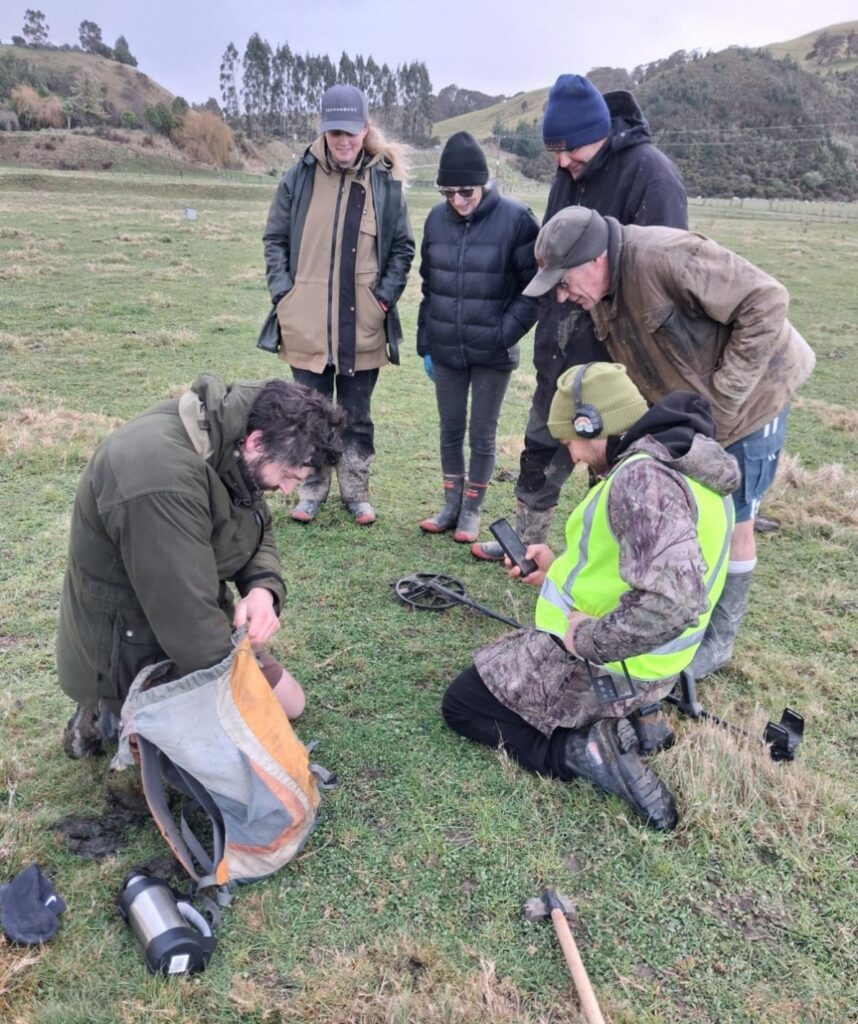
Recognising the possibility of a meteorite on the ground, Fireballs Aotearoa organized a search of the predicted strewn-field. After several days of searching, four small fusion encrusted fragments were discovered, weighing 8, 9,12 and 40 grams. There were no craters because the impact of very small meteorites is really more of a small bump as they “fall” at terminal velocity.
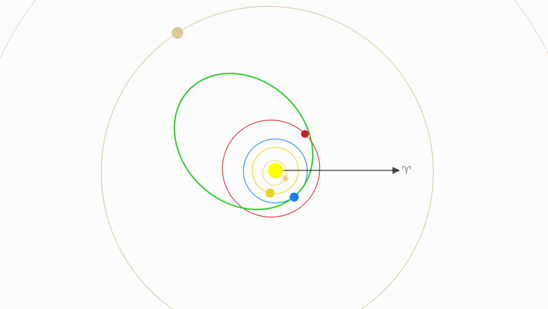
“The trajectory that the rock followed prior to entering the atmosphere indicates that that it was derived from the Asteroid Belt. The rock is therefore certainly from the start of the Solar System and almost 4.6 billion years old. We are lucky that after such a long duration it landed in New Zealand, and now will be formally classified by Marshall Palmer as soon as possible, given an official name and will become New Zealand’s 11th documented meteorite.
“Should people find black rocks in the area surrounding Masterton that they suspect could be a meteorite, they should photograph the rock and location, carefully bag the sample and contact FireballsAotearoa@gmail.com to confirm its origin. Please respect landowners rights” said Steve Wyn-Harris.
Here’s how the print media reported the arrival of Ruamāhanga
- https://www.odt.co.nz/news/dunedin/dunedin-geologist-part-of-crack-team-that-discovers-visitor-from-space-mpqjmw5l
- https://www.theguardian.com/world/2026/aug/11/meteorite-hunters-metor-fragments-new-zealand
And here are three links to interviews given in the days and weeks after the fall
- https://www.rnz.co.nz/national/programmes/afternoons/audio/2019045373/fiery-object-seen-in-the-sky-what-was-it-and-where-did-it-land
- https://www.rnz.co.nz/national/programmes/afternoons/audio/2019046517/meteorite-found-in-the-wairarapa
- https://media.rnztools.nz/rnz-kete-oro-prod/video/private/ac_mp3,af_48000,br_192k,f_mp3,fl_attachment/v1787533732/audio/clife/clife-20260821-1942-great_balls_of_fire_tiny_rocks_and_a_very_big_paddock_fixed.mp3