
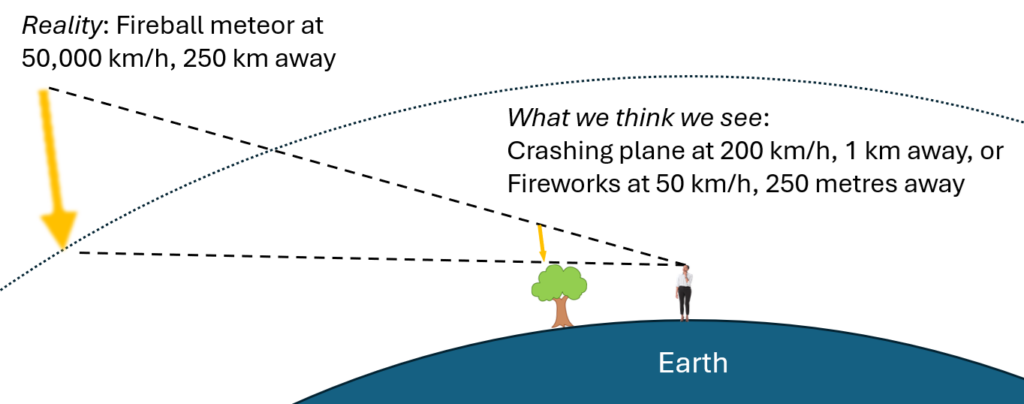
If a fireball meteor looks like it landed nearby, it probably landed around 250 kilometres away. If you don’t see it landing, it may have landed near you! This paradox has an explanation in two parts:
Why it seems nearer
“Like a firework” or “I thought it was a crashing plane” are frequent descriptions of fireball events. This is normal!
Fireball meteors arrive at about 15 kilometres per second, or about 50,000 km/h. But a “crashing plane” 1km away or a “firework” 250 metres away each have the same apparent speed as the fireball, because they travel through the same angle in the same amount of time. Our brains interpret the event as slower and closer than it actually is.
Why it seems to have landed
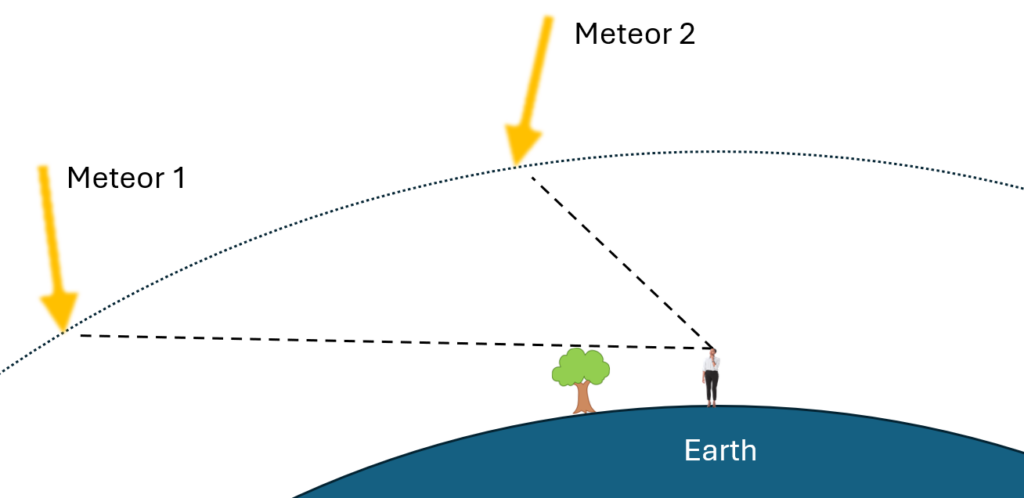
The Earth’s surface is curved, so a distant meteor (Meteor 1, below) may seem to have landed behind trees or houses. A closer meteor (Meteor 2) will seem to end high in the sky.
The Nininger Paradox
If you combine these two effects – seeming nearer and seeming to have landed, you get the Nininger Paradox. A distant fireball meteor will seem very close and may look as though it has landed nearby. But in reality, if you saw a meteor land “behind that hedge” or “behind that row of houses”, it was probably around 250 kilometres away.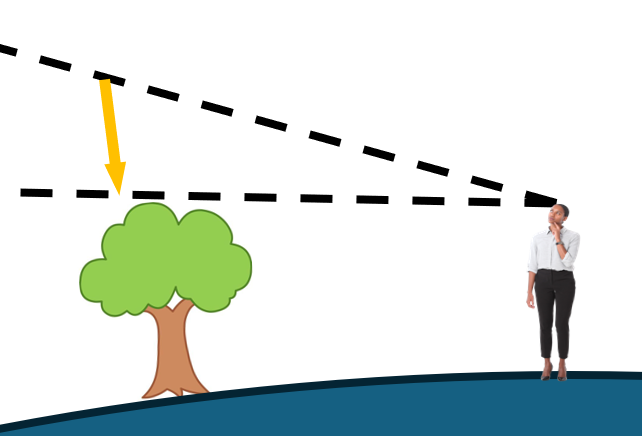
This paradox is named after Harvey Harlow Nininger (1887-1986). In his 1972 book “Find a Falling Star”, he describes his many meteorite hunts in the 1920s and 1930s. Every time, people reported a fireball landing ‘behind the haystack’ or ‘just back of the barn’ or ‘on the other side of the hill’. See pages 247-255 of the 2024 revised version (In Search of Falling Stars: H.H. Nininger’s Classic “Find a Falling Star” Revisited & Expanded) for an entertaining read.